PFAS-free water treatment plant in harmony with nature
PFAS removal equipment business
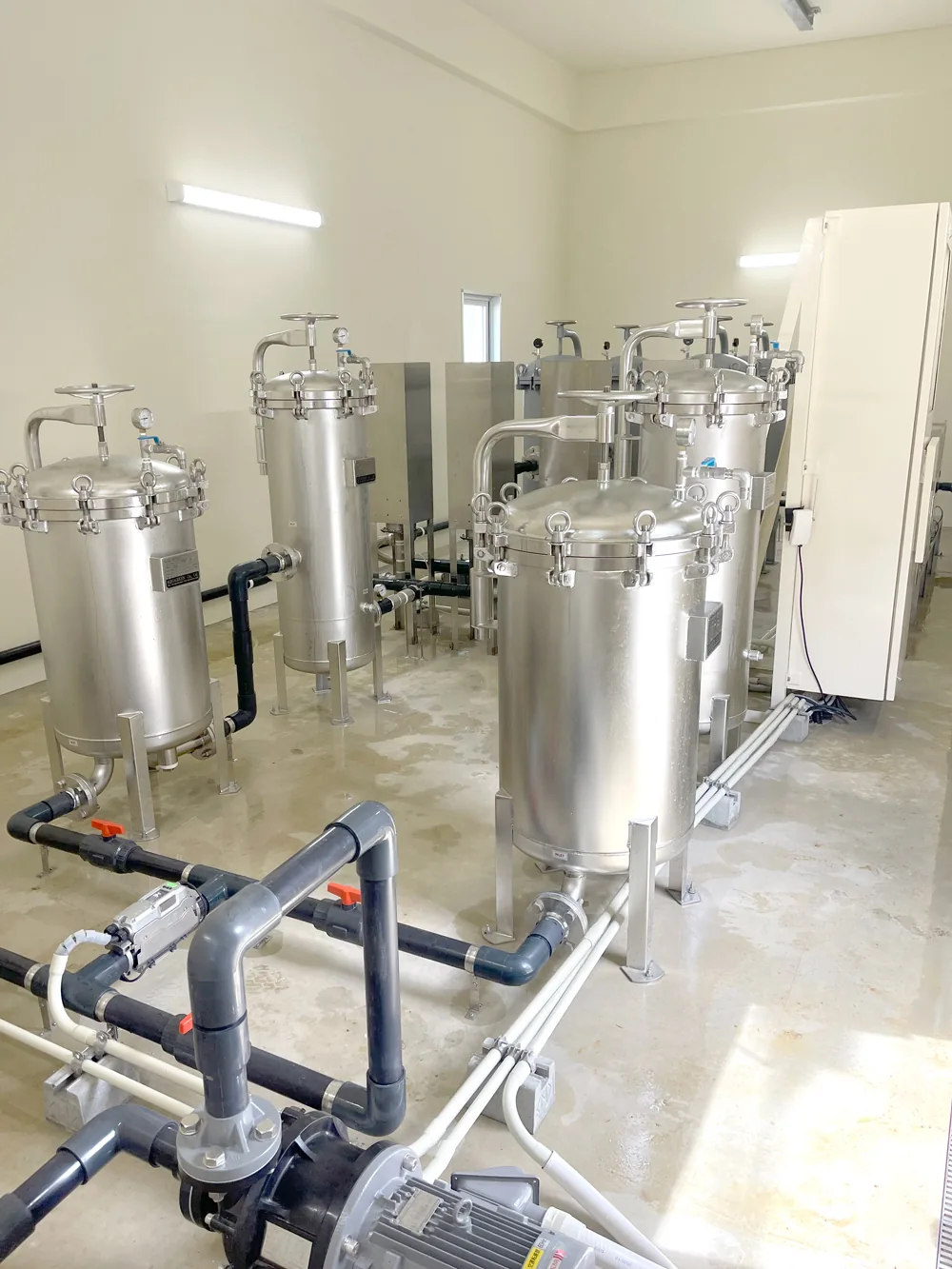
Clean water for the future.
We will realize a PFAS-free society.
PFAS removal using a combination of ozone and activated carbon treatment
By complementing the strengths of each technology, we achieve high efficiency and economy that cannot be achieved by a single process.
This is a cutting-edge water treatment plant that has been installed in a variety of locations, including public park ponds, industrial wastewater, and groundwater.
What are PFAS?
PFAS - Forever Chemicals
- PFAS (per- and polyfluoroalkyl substances) is a general term for organic fluorine compounds that have properties such as water repellency, heat resistance, and stain resistance, but are also considered problematic as hazardous substances that are hardly decomposed in nature.
There are concerns about contamination of drinking water and groundwater, and regulations are being strengthened both domestically and internationally.
Technology and Mechanism
Water treatment plant technology to remove PFAS
Our water treatment plants efficiently remove PFAS through a three-stage process of adsorption, decomposition, and separation.
By combining activated carbon, ion exchange resins, and advanced oxidative decomposition technology, we are able to improve the safety of treated water.
Main advantages of combined processing
1.Improved adsorption efficiency and lifespan of activated carbon
- Reducing organic matter load
PFAS-contaminated water also contains organic matter other than PFAS (such as DOM).
Ozone oxidizes and decomposes these organic substances, so introducing ozone as a pretreatment before activated carbon
reduces the amount of non-PFAS matter to be adsorbed and improves adsorption performance. - Suppression of competitive adsorption
Suppresses "competitive adsorption," in which PFAS and other organic matter compete for adsorption sites.
Activated carbon is more efficient at capturing PFAS, which is its intended purpose. - Reduced replacement frequency and costs
The reduced organic load extends the time until the activated carbon is saturated,
and the lower replacement frequency reduces operating costs.
2.Improved stability of PFAS removal
Activated carbon has a very high adsorption capacity for long-chain PFAS such as PFOS and PFOA.
Stabilizing water quality through ozone pretreatment allows the activated carbon to always operate under optimal conditions, maintaining stable PFAS removal performance.
3. Possibility of partial structural changes in PFAS (limited)
It is difficult to completely decompose PFAS using ozone alone.
Some studies suggest that ozone may oxidize and shorten the side chains of PFAS molecules .
This change may also have a favorable effect on the activated carbon adsorption behavior in the subsequent stage.
(*This is not a major effect and does not result in complete decomposition.)
4. Flexibility of the treatment process
In addition to PFAS countermeasures, ozone treatment can also improve water quality in multiple ways, including:
- Sterilization
- Deodorization
- Turbidity reduction
This allows for the creation of a flexible treatment process that can address other water quality issues while also removing PFAS .
Points to note
- Ozone alone has limited effect on PFAS degradation
Although it is a powerful oxidant, its ability to cleave the C–F bonds and completely degrade PFAS is limited.
The purpose of this combined treatment is to "maximize the performance of activated carbon." - Limitations with short-chain PFAS
Activated carbon does not adsorb short-chain PFAS (e.g., PFHxA, PFBS, etc.) well.
Since dramatic improvement cannot be expected with ozone pretreatment,
If short-chain PFAS are the main target, consideration should be given to using it in combination with reverse osmosis membranes (RO) or ion exchange resins . - Increased facility and operational costs
As combined processing becomes more sophisticated, the initial investment and operational management become somewhat complicated.
Summary
The combination of ozone treatment and activated carbon treatment is
- Maximizes the PFAS adsorption capacity of activated carbon
- Extends activated carbon life and reduces operating costs,
making it a practical and cost-effective PFAS countermeasure technology.
Implementation track record

[Case Report] PFAS Reduction at Wakatake Park, Ginowan City
Wakatake Park Pond Restoration Project — At Wakatake Park in Ginowan City, high concentrations of PFAS had been detected in the pond water, and use of the pond was restricted for a long period. In May 2025, Okinawa Environmental Engineering installed an advanced ozone treatment system with a capacity of 18–20 tons per hour for the pond, which is fed by the park's spring water. By purifying a large volume of water in a short time, PFAS (PFOS and PFOA) concentrations were dramatically reduced from 490 ng/L to below 1 ng/L. Water quality improved dramatically, clean water returned to the pond for the first time in five years, and the park is once again a safe place for children to play.
FAQ
PFAS / PFOS CountermeasuresHow much can concentrations be reduced?
(evaluated on the basis of analytical results).
What are the guideline values in Japan?
please consult us about your specific case.
Can you handle projects outside Japan?
We propose designs tailored to the target values.
Can ozone alone decompose PFAS?
We design optimal systems on this basis.